Understand the grounds
Melbourne Park is a collection of arenas and courts, not one stadium. A broadcast may move between enclosed architecture, open stands and courts with spectators close to the baseline. Learning the venue names helps you recognise these changes and read the order of play without mistaking a court assignment for a different competition.
Place Melbourne Park in the city
Melbourne Park belongs to the Melbourne sports and entertainment precinct on the northern side of the Yarra River. The Melbourne Cricket Ground, often called the MCG, stands nearby in Yarra Park. AAMI Park is another recognisable neighbour, associated with rectangular-field sports rather than Australian Open match courts.
These landmarks help orient a wide television shot, but they are not interchangeable entrances or tennis venues. Federation Square and Flinders Street Station are well-known central Melbourne reference points to the west of the precinct. For an actual journey, use current public transport information and the tournament’s published access map rather than estimating from a broadcast panorama.
The arena names are useful when reading schedules because several matches can run at the same time. “Melbourne Park” identifies the broader site; a specific court name narrows that to the place where a contest is assigned.
Recognise the three principal arenas
- Rod Laver Arena
- Named for Australian champion Rod Laver, this is the tournament’s principal stadium and the familiar setting for the senior singles finals. Its retractable roof and surrounding stands give broadcasts a recognisable arena backdrop. A match here belongs to the same draw as a match on an outside court.
- Margaret Court Arena
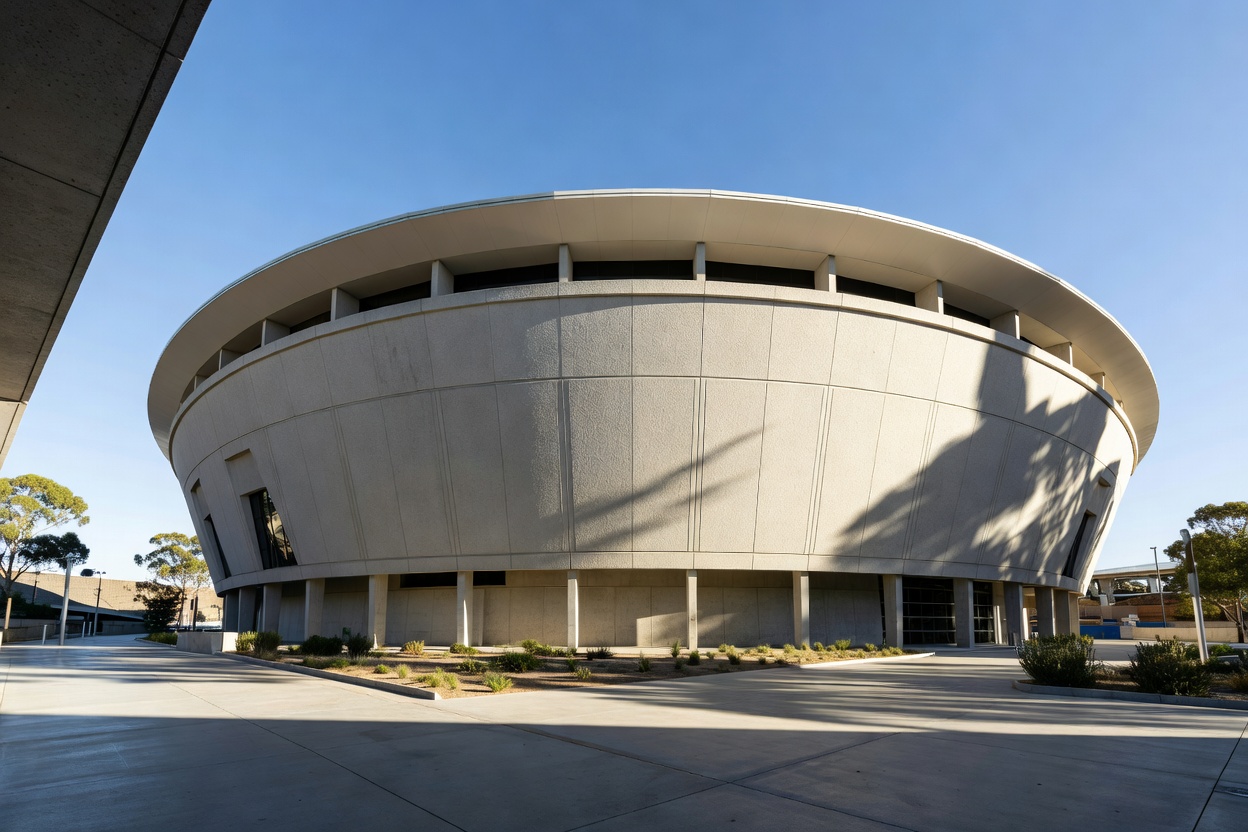
- This arena carries the name of another major Australian tennis champion. Its retractable roof and more compact stadium setting distinguish it from an uncovered outside court. It provides a substantial show-court stage without being the event’s principal finals arena.
- John Cain Arena
- Named after a former Premier of Victoria, this is a multipurpose arena within the precinct and an important Australian Open venue. It has a retractable roof and has also been known under earlier names, so archive footage and older guides may label it differently.
The presence of a roof does not mean it stays closed throughout the tournament. Roof use and interruptions depend on conditions and tournament decisions. Do not infer the day’s arrangements solely from an arena’s architecture.
Give the outside courts their own role
Kia Arena is another named show court within Melbourne Park, with an open-air setting. Outside courts also carry numbered labels in match listings. These places are part of the competitive programme, not merely practice areas or overflow space for less meaningful tennis.
A show court is a court designed to accommodate a substantial audience and presentation. “Outside court” generally distinguishes courts beyond the principal enclosed arenas; it does not define a separate standard of rules. Early-round singles, doubles and other competitions can all appear across the grounds.
From a viewer’s perspective, smaller stands can make player movement and crowd responses feel immediate. Wider stadium shots offer more architectural context. Neither angle changes whether the ball is in, the set score or the consequence of winning the match.
Read access and court assignment separately
A court appearing in the schedule does not establish that every admission category includes it. Ground access, reserved seats and session boundaries are practical arrangements that must be checked in the organiser’s information for the visit concerned. No lasting venue description can substitute for those conditions.
- Find the court name attached to the match, not just the player’s name.
- Check whether an assignment has changed before relying on an earlier listing.
- Keep the site map separate from the draw: one describes locations, the other competitive paths.
- Check accessible routes and facilities in venue information if they matter to your visit.
For viewers watching remotely, the same separation helps. A channel may concentrate on Rod Laver Arena while another stream covers a numbered court. A match can be taking place without appearing on the main broadcast.
Compare the setting without ranking it
Wimbledon’s Centre Court and Roland-Garros’s Court Philippe-Chatrier serve as familiar principal-stadium counterparts. At the US Open, Arthur Ashe Stadium plays a similar headline role. Their identities help explain why tournament broadcasts repeatedly return to one major arena while other courts remain active.
Melbourne Park’s particular character is the combination of a central-city sports precinct, blue hard courts and several roofed arenas. Recognising that pattern gives a newcomer a stable visual framework, even when court allocations and the daily programme change.